
Glulam Beams

What Is a Glulam Beam?

A Glulam Beam (glued laminated timber) is an engineered wood member made by face-bonding individual lumber laminations, typically 1-1/2 inches thick, into one structural unit. Unlike solid sawn timber, which is limited by the size of the tree, glulam can be manufactured in almost any depth, width, and length a design requires.

The lamination process spreads natural defects (knots, grain deviation) across many layers, producing more consistent and predictable structural properties than any solid-wood alternative. Higher-grade laminations go on the outer faces, where bending stress is greatest; lower-grade material fills the less-stressed core, an efficient use of the log that maximizes performance per board foot.

Glulam is one of the oldest and most proven engineered wood products, in structural use for more than a century. Today it serves as beams, columns, arches, trusses, and framework in buildings, bridges, and structures of every scale.

How
Glulam Beams
Are Made

Glulam is manufactured to the ANSI A190.1 standard through a controlled, engineered process:

Lumber selection & grading

Dimension lumber is graded for strength and stiffness; the strongest material is placed in the high-stress tension and compression zones.

Moisture conditioning

Laminations are dried to a controlled moisture content (typically 16% or less) for dimensional stability and bond quality.

Finger jointing

Boards are end-joined with structural finger joints to create continuous laminations of any length.

Adhesive application

Waterproof, non-toxic structural adhesives bond the lamination faces — a bond stronger than the wood itself.

Assembly & pressing

Laminations are stacked in the engineered layup and clamped under pressure until cured into a single monolithic member.

Finishing

Cured beams are planed to final dimensions; appearance-grade beams receive additional surface finishing for exposed use.

Why Glulam /
Why RedBuilt

Glulam gives design teams a structural material that spans farther, weighs less, performs predictably in fire, and is aesthetically pleasing when left exposed — all from a renewable resource. RedBuilt adds the design, fabrication, and local support that turn the material into a delivered structure.

V8 and V4 layup options

Balanced and unbalanced configurations matched to your exact loading conditions.

System integration

Glulam coordinates with RedBuilt open-web trusses, Red-I joists, RedLam LVL, and wall panels for a complete engineered-wood structure.

Custom fabrication

Straight, curved, arched, tapered, and custom-shaped members built to your specifications.

In-market technical reps

A local representative provides design support, budget pricing, and coordination from spec through installation.

Multiple appearance grades

From concealed framing grade to premium grade for exposed features and species.
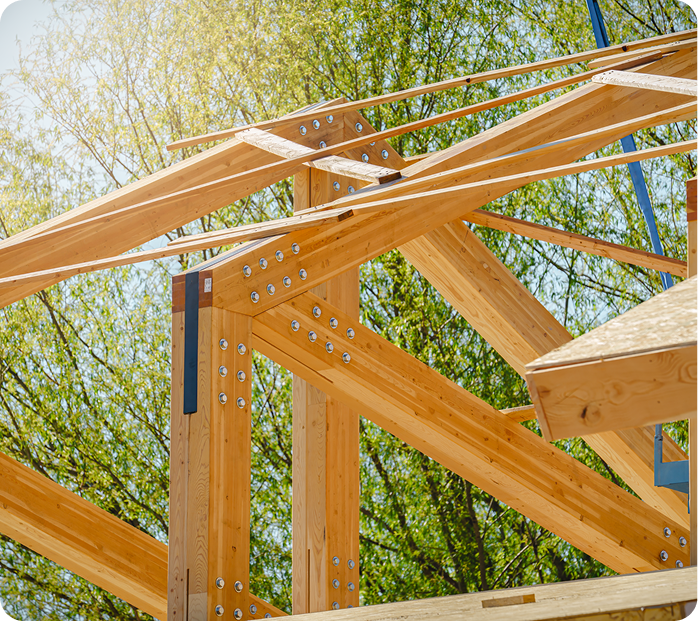
Benefits & Structural Performance

Glulam delivers performance that makes it a direct alternative to steel and concrete in many commercial applications:

High strength-to-weight ratio

Pound-for-pound stronger than steel, reducing foundation loads and simplifying handling and installation.

Long spans

Straight beams commonly span 40 to 100+ feet; arched and curved members reach hundreds of feet for arena and bridge work.

Predictable fire performance

Large timber chars at a known rate (~1.5 in./hr) instead of losing strength suddenly like steel — enabling fire-rated designs without spray-on fireproofing.

Dimensional stability

Controlled moisture content and lamination minimize warping, twisting, and shrinkage after installation.

Design flexibility

Curved, tapered, pitched, and custom shapes are fabricated from the same structural-grade material.

Glulam beams are specified against steel because they combine structural capacity with lower weight, predictable fire behavior, simpler installation, and a finished appearance.

This comparison serves the comparative search intent behind “glulam vs steel beam”.

Strength-to-weight

Stronger per pound than steel; lighter members reduce foundation loads.

Fire performance

Chars predictably (~1.5 in./hr); retains capacity during fire exposure.

Spans

Straight to 100+ ft; arches to 500+ ft.

Shapes

Curved, arched, tapered, custom — from standard material.

Appearance

Natural wood warmth for exposed use; multiple appearance grades.

Sustainability

Renewable; sequesters carbon; lower embodied energy.

Installation

Standard wood connections; field-drilled with conventional tools.

Steel

Strength-to-weight

Higher absolute strength but heavier per linear foot.

Fire performance

Loses strength rapidly above ~1,000°F; needs spray-on fireproofing for rated assemblies.

Spans

Long spans possible but at higher cost and weight.

Shapes

Custom shapes need expensive forming, welding, fabrication.

Appearance

Industrial look; requires cladding or paint to finish.

Sustainability

High embodied energy; recyclable but energy-intensive to produce.

Installation

Welding, crane lifts, specialized ironworker labor.

Strength-to-weight

Stronger per pound than steel; lighter members reduce foundation loads.

Fire performance

Chars predictably (~1.5 in./hr); retains capacity during fire exposure.

Spans

Straight to 100+ ft; arches to 500+ ft.

Shapes

Curved, arched, tapered, custom — from standard material.

Appearance

Natural wood warmth for exposed use; multiple appearance grades.

Sustainability

Renewable; sequesters carbon; lower embodied energy.

Installation

Standard wood connections; field-drilled with conventional tools.

Strength-to-weight

Higher absolute strength but heavier per linear foot.

Fire performance

Loses strength rapidly above ~1,000°F; needs spray-on fireproofing for rated assemblies.

Spans

Long spans possible but at higher cost and weight.

Shapes

Custom shapes need expensive forming, welding, fabrication.

Appearance

Industrial look; requires cladding or paint to finish.

Sustainability

High embodied energy; recyclable but energy-intensive to produce.

Installation

Welding, crane lifts, specialized ironworker labor.

Sizes, Layups & Appearance Grade

Appearance Grades

Glulam is available in four standard appearance classifications (ANSI A190.1). Appearance grade affects visual quality only — not structural performance:

Premium grade

Highest classification for high-visibility features; selected-grain faces, minimal visible defects (usually custom order).

Architectural grade

Exposed applications needing a clean, consistent look; filled knot holes, smooth surface.

Industrial grade

Beams that may be visible but don’t need a refined finish; moderate surface quality.

Framing grade

Concealed applications where only structural performance matters; surface imperfections acceptable.

Balanced (V8) and Unbalanced (V4) Layups

Glulam is manufactured in two fundamental layup configurations, each engineered for a different structural condition:

V8 — balanced layup

Identical high-strength laminations top and bottom give equal bending capacity in both directions. Specified for columns and members with axial loads, reverse bending (wind uplift, cantilevers), or continuous spans where the tension zone alternates.

V4 — unbalanced layup

Higher-grade laminations on the bottom (tension) face optimize the beam for simple-span, one-direction bending. More material-efficient, with the best strength-to-cost ratio for standard beam application.

Sizes & Dimensions

Glulam is manufactured in standard and custom sizes to meet virtually any structural requirement.

Straight beams and columns

Standard floor, roof, and post applications.

Tudor arches

Classic pointed-arch profiles for worship spaces and assembly halls.

Radial arches

Curved members for domed and barrel-vault structures.

Pitched and tapered beams

Varying depth for drainage slope or architectural expression.

Three-hinged arches

Long-span systems for gymnasiums, arenas, and bridges.

Custom curves

Any radius within the minimum bending limits for the lamination thickness.

Shapes & Custom Fabrication

Glulam’s biggest advantage over other structural materials is the ability to fabricate curved, arched, and custom shapes that would be prohibitively expensive or impossible in steel or concrete:

Applications & Building Types

Glulam is specified across the widest range of building types of any engineered wood product:

Sustainability & Environmental Performance

Glulam offers measurable environmental advantages over steel and concrete:

Carbon sequestration

Wood stores the carbon absorbed during tree growth; a glulam beam keeps sequestering it for the life of the building.

Lower embodied energy

Manufacturing glulam takes significantly less energy than equivalent steel or concrete members.

Renewable resource

Wood is the only major structural material that is grown, not mined; responsible forestry sustains long-term supply.

Efficient material use

The layup process puts lower-grade lumber in less-stressed zones, maximizing the value of each beam.

Green building credits

Glulam supports LEED®, Green Globes®, and similar systems through biobased-material credits and Environmental Product Declarations (EPDs).

Resources and Downloads

Everything your team needs to specify, design, and install Glulam Beams — from product guides to our safety data sheets.

National Presence

RedBuilt manufactures and supports glulam from multiple U.S. locations, with technical representatives in your market.

Ready to Spec RedBuilt Glulam Beams?

Our technical sales team are in your market, ready to assist with beam design, BIM
coordination, budget pricing, and support from design to installation.

Products

Open-Web Trusses

Red-I™ Joist

Prefabricated Wall Panels

Glulam Beam

Laminated Veneer Lumber

Plated Trusses

Cross Laminated Timber

Mass Plywood Panel

Connections and Fasteners

Open-Web Trusses

Red-I™ Joist

Prefabricated Wall Panels

Glulam Beam

Laminated Veneer Lumber

Plated Trusses

Cross Laminated Timber

Mass Plywood Panel

Connections and Fasteners

Open-Web Trusses

Red-I™ Joist

Prefabricated Wall Panels

Glulam Beam

Laminated Veneer Lumber

Plated Trusses

Cross Laminated Timber

Mass Plywood Panel

Connections and Fasteners

Open-Web Trusses

Red-I™ Joist

Prefabricated Wall Panels

Glulam Beam

Laminated Veneer Lumber

Plated Trusses

Cross Laminated Timber

Mass Plywood Panel

Connections and Fasteners

Open-Web Trusses

Red-I™ Joist

Prefabricated Wall Panels

Glulam Beam

Laminated Veneer Lumber

Plated Trusses

Cross Laminated Timber

Mass Plywood Panel

Connections and Fasteners